Tuesday, January 19, 2016

Why Do They Use Metal Chopsticks in Korea?

Admittedly this has only a tangential relationship to both China and street food, but I thought this article was interesting and wanted to pass it along. The question: why do Korean people (apparently) use metal chopsticks, when most of the chopstick-using world favors wooden or bamboo chopsticks?

Here's a helpful graphic from the article.

One theory proposed by the article:
One major theory is that royalty during the Baekje period began using silver chopsticks as a way of protecting themselves from being poisoned by their enemies, as the silver would change color when in contact with a poisonous chemical. 

Interesting thought. The article also lists several other theories, all of which seem to have a reasonable level of plausibility. I wouldn't want to steal all their thunder (and page clicks), so I'll avoid sharing those other theories and let you click on over to read more on your own. Just some fun stuff to file away in the "you learn something new every day" category.

Thursday, January 14, 2016

Four Year Update

In a pleasant little confluence of events, the very same day I left for China to conduct research for my book, some of our favorite friends had their second child. Earlier this week, that child turned four. Unbelievably, this means it has been four full years since I embarked on my big China journey. I never imagined it would take so long to get this book out into the world, and yet here we are.  Some delays have been worthwhile and some haven't, but all have contributed to the long process. 

All that being said, you may be asking where things stand with the book right now. Well, here's the good news: earlier this week I sent my last bit of text to the publisher! What a lovely feeling to have that off my plate. Now the publisher is working on layout and design. Once that's complete, I think we'll be pretty close to publication. Stay tuned here for updates in the coming months.

In the meantime, thanks for your continued readership and interest. I'm grateful to every set of eyes that has skimmed through this page.

Wednesday, November 11, 2015

Street Food in the Michelin Guide

Good news! Hong Kong street food is going to be featured in the Michelin Guide for the first time. According to this article 23 different street vendors will be reviewed in the storied guide. Does this matter? Maybe, maybe not. Perhaps it adds some legitimacy to street food as an important world cuisine; perhaps it takes some of the fun out of the "street" part of street food. I'm optimistic, so I'll lean towards the former. In any case, there are thousands of street vendors in Hong Kong, and it's nice to know that some of them are getting some recognition.

Hong Kong's famous egg pancake

Saturday, August 15, 2015

The Cleaver Quarterly

Apologies are in order. I try to share press coverage on this site as soon as it comes out, but I am a little bit late on this one. It's worth the wait, though, I promise. Today I am happy to finally share with you, dear reader, this article I wrote for the excellent, print-only, Chinese-food-focused magazine The Cleaver Quarterly. My topic: street food head to toe (and everything in between).

If you want to look at the whole magazine (and you should...it's a beautifully assembled magazine with loads of interesting content), you'll need to buy it either from a physical location or from their online shop. That being said, I've been granted permission to share the proof of my own article here. I've embedded the PDF below, and I've linked directly to it here.

If you look at nothing else, I'd encourage you to check out the illustration that forms the centerpiece of the article. It's a magnificent street food chimera based on the foods in my article. Many thanks to Ru Brown for this fantastic visual accompaniment.


Outstanding, right?  Anyway, without further ado, here's the embedded article. Thanks to The Cleaver Quarterly for inviting me to contribute this article, and thanks to you for reading.


Saturday, May 23, 2015

Sea Worm Jelly

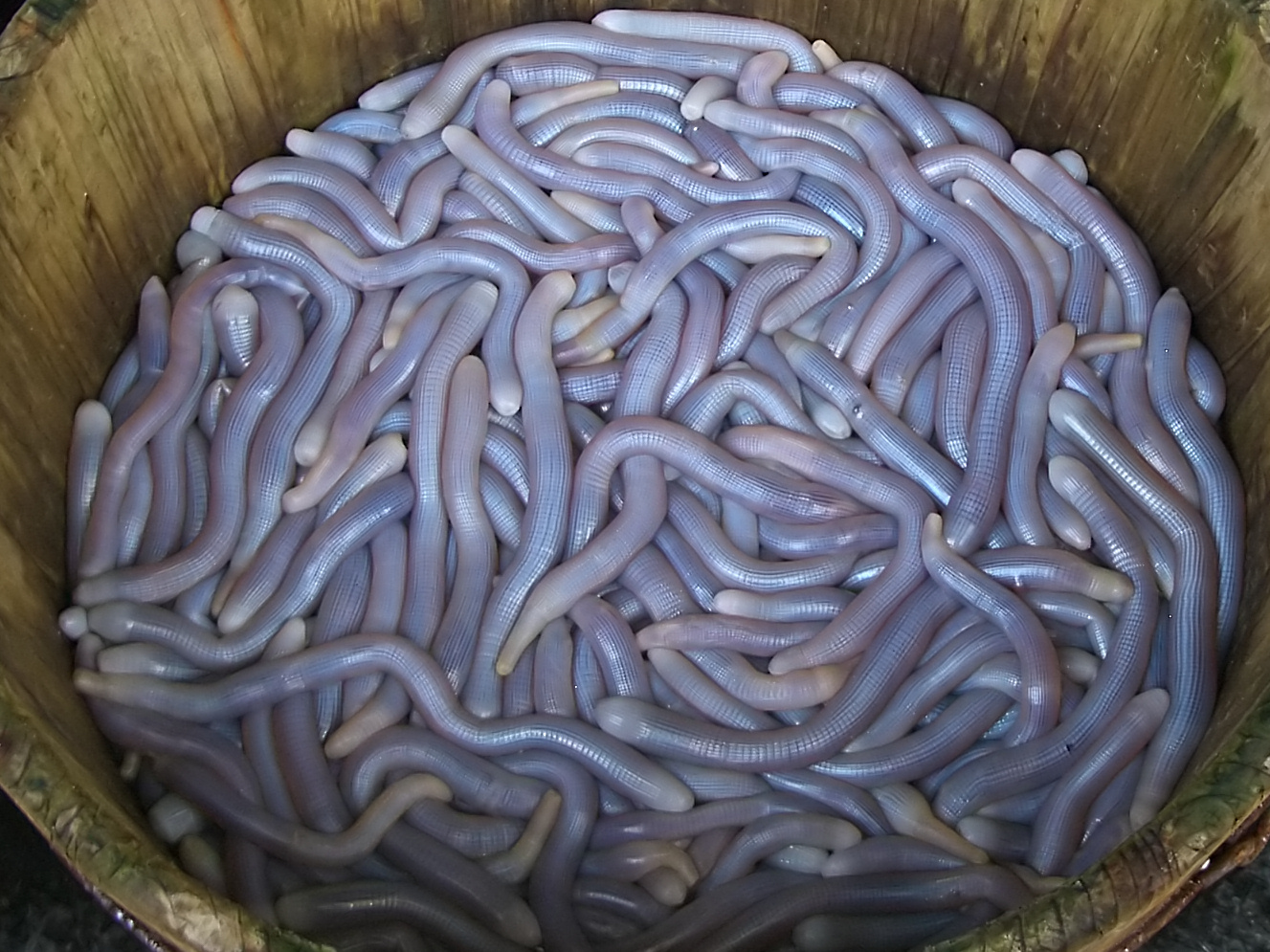
Though it may sound unappetizing, most translators end up calling Xiamen's 土笋冻 (tŭ sŭn dòng) “sea worm jelly.” Perhaps you think this is a colorful euphemism, or a lost-in-translation moment. In fact, sea worm jelly is exactly what this is.


The primary ingredients are sipunculid worms harvested from shallow water and muddy beaches on the coast of Fujian.

Here's what they look like. Photo credit: Wikimedia User:Vmenkov

A bunch of these worms are boiled, which releases a slimy collagen into the water that functions similarly to pectin. As the water cools, it is poured into small molds to set like gelatin. A short while later you’ve got small, firm, wiggly mounds of cloudy yellow-gray gelatin in which are suspended long, white worm carcasses. Before you receive a bowl of tŭ sŭn dòng, the vendor will cover it with some combination of chili sauce, mustard, wasabi, soy sauce, vinegar, and cilantro to give it some strong flavors. So what does sea worm jelly taste like, I hear you asking? Frankly, not too much on its own. It tastes and feels like cool, smooth, unflavored (albeit mildly sour and briny) gelatin with some slightly chunkier textures within. The real flavor comes from the sauces on top, which can give it a powerful, sinus-clearing kick. One of the joys of street food is finding truly novel things to eat, and a gelatin made from boiled worms dug up from beach mud is likely to be mightily novel for most people. For a uniquely local street food experience, you really can’t go wrong with tŭ sŭn dòng.

Wednesday, May 20, 2015

Big News

Hello, friends, followers, Sinophiles, and street food lovers. As you might know, I've been working on this book for a good long time now. Several months ago, I posted a three-year update explaining where things stood on getting it out onto the market. Among the reasons I cited for it not being finished was that I was taking some time to look for a publisher, rather than going straight to self-publishing. At the time I said, "I am going to keep heading that direction [i.e. searching for a publisher] for a few more months. If nothing pans out then I will go the self-publishing route."

Well, here we are a few months later, and I'm very pleased to announce that something did, in fact, finally pan out. Today I'm happy to share that I officially have a publisher for my book! My new favorite publishing house is Blacksmith Books, an independent Hong Kong-based publisher that "focuses on publishing China-related non-fiction." The contract is signed and we are now moving forward into the editing stage of the process. If they are looking forward to working with me as much as I am looking forward to working with them, I think it's safe to say that this will be a great partnership.

So, big sigh of relief over here in North Carolina. No more emailing publishers and agents and getting no responses or "no" responses. I'm thrilled to be at the point where I am now--closer than ever to getting this book off of my computer and into a bookstore near you. If you're wondering when that might happen, I am afraid I don't have a clear answer for you. But you can be sure that I will keep you updated here (and on my Facebook page). In the meantime, sit tight and know that Blacksmith and I are working hard to have a finished copy in your hands as soon as possible.

So that's the update. Thanks to all for your continued support. This has been a long process, and I am ever grateful for your steadfast readership and interest.

Saturday, March 21, 2015

Beer!

Ask anybody outside of China to name as many Chinese beers as they can, and I suspect very few would get past Tsingtao.

Right?

It is well-known throughout much of the world as well as in China, where it comes from the country’s second largest brewery. So why would a beer available in its recognizable green bottles all over the world be included on a website meant to highlight hyper-local street foods? Easy: because in its home city of Qingdao (Tsingtao is an earlier transliteration of the city’s name), you can purchase it by weight on the street. The Tsingtao brewery was founded in the early twentieth century when Qingdao was under German rule as part of the Kiautschou Bay concession (1898 – 1914). Of course establishing a brewery was a priority for the Germans living in Qingdao, so they built it in 1903 and it has been operating ever since. Think about that—it has stayed open while the city was controlled by Germany, Japan (twice), the Republic of China, and the People’s Republic of China. It was nationalized for many years (at which time the Chinese government changed some of the strict German beer rules to allow rice in the recipe) until the early 1990s when it was privatized once again. The Tsingtao brewery has been through a lot during its long history in the area, and it is a source of pride for many citizens. So in a way, it is no surprise that the brewery’s flagship product is available all over the city. Poke your head into many of the city’s hole-in-the-wall restaurants and you will find a keg of beer waiting for you. Ask the vendor for a bag (yes, a bag), fill it up as much as you want, weigh it, pay for it based on the weight, and you’re on your way.


You can either drink it right out of the bag or relocate it to a mug when you reach your destination. Qingdao is the only city I’ve ever visited where you can buy beer in a bag by the kilogram and then drink it as you wander the streets. It’s a unique opportunity that has resulted from the city’s unique history. Don’t miss it.