Showing posts with label Street Food Reviews. Show all posts

Friday, February 2, 2018

Yù Lán Bĭng

As I mentioned in my last post, I expect to have some big updates on the publishing front in the near future. To celebrate, I thought I'd post a new street food review (that's really why everyone comes here, right? Let's be honest...). Today's spotlight is on Wuxi's yù lán bĭng (玉兰饼): one of my favorite Chinese street foods in the "small snacks" category. Wuxi is so close to Shanghai that it doesn't seem to get the credit it deserves as its own city, but I actually found that some of the food there gave Shanghai cuisine a major run for its money. Yù lán bĭng is a good example of such a dish. The basic description is simple: a fried, hollow ball of glutinous rice is stuffed with a sweet pork meatball. That’s all it is. And yet it is completely delicious.

Simple on the outside

Heaven on the inside 

The glutinous rice ball is fried to a crisp golden brown on the outside wall, while the interior wall is left white and sticky. The pork meatball inside is mildly sweet (some vendors' recipes include rosewater!) and succulent—very juicy. A lot of meat-in-dough foods in China end up with the stuffing clinging pretty closely to the casing, but in the case of yù lán bĭng the pork and the rice are distinct from one another. Like two nesting dolls, the meatball just sits inside of the glutinous rice ball. This unassuming little street food is oily, sweet, chewy, and meaty, just bursting with juice and flavor. Buy yourself one or two or ten—you won’t regret it.

Saturday, May 23, 2015

Sea Worm Jelly

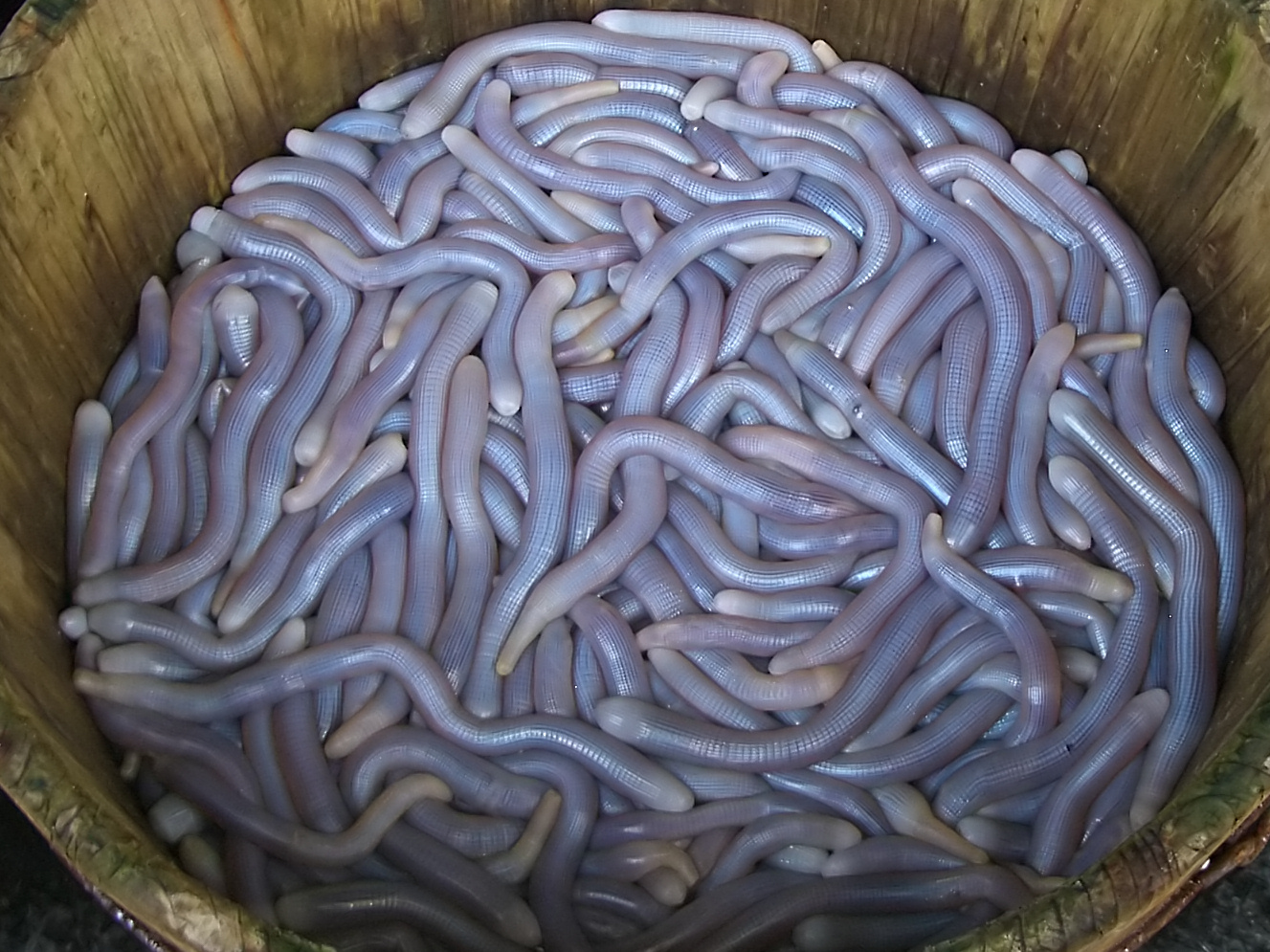
Though it may sound unappetizing, most translators end up calling Xiamen's 土笋冻 (tŭ sŭn dòng) “sea worm jelly.” Perhaps you think this is a colorful euphemism, or a lost-in-translation moment. In fact, sea worm jelly is exactly what this is.


The primary ingredients are sipunculid worms harvested from shallow water and muddy beaches on the coast of Fujian.

Here's what they look like. Photo credit: Wikimedia User:Vmenkov

A bunch of these worms are boiled, which releases a slimy collagen into the water that functions similarly to pectin. As the water cools, it is poured into small molds to set like gelatin. A short while later you’ve got small, firm, wiggly mounds of cloudy yellow-gray gelatin in which are suspended long, white worm carcasses. Before you receive a bowl of tŭ sŭn dòng, the vendor will cover it with some combination of chili sauce, mustard, wasabi, soy sauce, vinegar, and cilantro to give it some strong flavors. So what does sea worm jelly taste like, I hear you asking? Frankly, not too much on its own. It tastes and feels like cool, smooth, unflavored (albeit mildly sour and briny) gelatin with some slightly chunkier textures within. The real flavor comes from the sauces on top, which can give it a powerful, sinus-clearing kick. One of the joys of street food is finding truly novel things to eat, and a gelatin made from boiled worms dug up from beach mud is likely to be mightily novel for most people. For a uniquely local street food experience, you really can’t go wrong with tŭ sŭn dòng.

Saturday, March 21, 2015

Beer!

Ask anybody outside of China to name as many Chinese beers as they can, and I suspect very few would get past Tsingtao.

Right?

It is well-known throughout much of the world as well as in China, where it comes from the country’s second largest brewery. So why would a beer available in its recognizable green bottles all over the world be included on a website meant to highlight hyper-local street foods? Easy: because in its home city of Qingdao (Tsingtao is an earlier transliteration of the city’s name), you can purchase it by weight on the street. The Tsingtao brewery was founded in the early twentieth century when Qingdao was under German rule as part of the Kiautschou Bay concession (1898 – 1914). Of course establishing a brewery was a priority for the Germans living in Qingdao, so they built it in 1903 and it has been operating ever since. Think about that—it has stayed open while the city was controlled by Germany, Japan (twice), the Republic of China, and the People’s Republic of China. It was nationalized for many years (at which time the Chinese government changed some of the strict German beer rules to allow rice in the recipe) until the early 1990s when it was privatized once again. The Tsingtao brewery has been through a lot during its long history in the area, and it is a source of pride for many citizens. So in a way, it is no surprise that the brewery’s flagship product is available all over the city. Poke your head into many of the city’s hole-in-the-wall restaurants and you will find a keg of beer waiting for you. Ask the vendor for a bag (yes, a bag), fill it up as much as you want, weigh it, pay for it based on the weight, and you’re on your way.


You can either drink it right out of the bag or relocate it to a mug when you reach your destination. Qingdao is the only city I’ve ever visited where you can buy beer in a bag by the kilogram and then drink it as you wander the streets. It’s a unique opportunity that has resulted from the city’s unique history. Don’t miss it.

Monday, January 26, 2015

Street Food Around the World

One of the fun things about writing this website and book is opening up my email account to find messages from strangers regarding street food. Not long ago I received one such email from Zara at Backpack ME asking if I wanted to contribute to a post documenting street foods around the world. I would, naturally, be representing China in that post. It sounded like fun, so I got on board. It was tough to choose a single street food to represent a country as massive and gastronomically diverse as China. There are so many great foods, some of which are currently available throughout the country and some that are really limited in geography. In the end, I settled on 煎饼 (jiān bĭng), as it seemed there was a solid argument to be made for it being the quintessential Chinese street food.


Despite it's Beijing/Tianjin origins, this greasy thrill for the taste buds is widely available in China. It also has all the hallmarks of a great Chinese street food (quick, cheap, greasy, and filling). All considered, it seemed as good a representative dish as any. So, I wrote up a paragraph or two and sent it off to Zara. Earlier today I got another email saying that the post had officially gone up. Besides my piece about China, there are entries from Mexico, Vietnam, Burma, Iran, Madagascar, Grenada, Tanzania, Slovakia, Romania, Egypt, Guatemala, and two dozen other countries. Wow! It's a terrific and remarkably mouth-watering list. What a wonderful reminder about the diversity of the human experience. I want to try all of them in one weeks-long street food binge.

Anyway, I encourage you to hop on over and check out the Street Food Around the World post. While you're there, poke around some of the other articles Zara and Ashray have posted--there's lots of good travel writing to discover. Thanks for the invitation, Backpack ME!

Friday, January 23, 2015

Peculiar Name; Great Taste

One of Tianjin’s most beloved street foods, 耳朵眼炸糕 (ĕr duŏ yăn zhá gāo) was invented around the turn of the 20th century by a man named Liu Wanchun. The hutong where he lived and sold his wares was, for some reason, named Ĕr Duŏ Yăn (“earhole”). Why? I don't know. Anyway, over time, as his sweet fried rice cakes became more and more well-loved in the city, they were identified with Mr. Liu and his earhole alley, which is how they became known as ĕr duŏ yăn zhá gāo: earhole fried rice cakes.


The non-orifice part of the name (i.e. "fried rice cake") gives you a pretty good idea of what you’re getting into here. A blob of yellow rice and glutinous rice dough about the size of a persimmon is stuffed with a mixture of red bean paste and brown sugar and then fried. What you end up with is a ball with a thin, crispy, blistered skin and a gooey, squishy, sweet interior. It is a delightful treat for the senses, particularly if you are a normal person who likes sweet and fried foods. A food that I have used the words “earhole” and “blistered” to describe might not sound very appetizing, but you’ll have to trust me—this one is a winner.

Sunday, January 4, 2015

Snail Noodle Soup

Thanks to some curious historical pigeonholing, Liuzhou is best known in China as a producer of coffins. This reputation even makes its way into a well-known Chinese saying about the key to a happy life that goes: 生在苏州, 活在杭州, 吃在广州, 死在柳州. This translates to something like “be born in Suzhou [a city reputed to produce the most beautiful people], live in Hangzhou [which is renowned for its scenic location], eat in Guangzhou [the seat of world-famous Cantonese cuisine], and die in Liuzhou.” Although the coffin industry casts a macabre pall over the city’s history and culture, it is not the only game in town; Liuzhou is also known for its delicious snail soup, known to locals as luó sī fĕn. 


Most people who hear about this snail soup expect at least a handful of the eponymous gastropods to lie in wait, lurking squishily within the shimmering, murky broth. This assumption is actually wrong, as snail meat is not a direct ingredient of luó sī fĕn. In fact, the soup gets its name because its base is snail stock. River snails and pork bones are stewed for hours with vendor-specific combinations of spices (generally including cardamom, fennel, star anise, cloves, pepper, and other similar spices) to create the distinctive broth. In addition to the snail broth, the recipe for luó sī fĕn includes a thick tangle of skinny rice noodles, crispy fried tofu skin, peanuts, pickled vegetables (this is Guangxi, after all), fresh green vegetables, and heaps of chili oil. This is usually a very spicy bowl of noodles with some intriguing contrasts of taste (spicy, sour, and faintly musty) and texture (slippery, crunchy, and soft). You can buy luó sī fĕn in nearby cities like Nanning and Guilin, but if you want the finest bowl of snail soup money can buy, I’d recommend making a stop right in Liuzhou. If nothing else, it will give you something other than coffins to remember the city for.

Tuesday, July 15, 2014

Ice Cream in a Very Cold Place

By far the most famous thing about Harbin is the bitter cold in the winter. Average winter temperatures reach down towards -20° C (-4° F), with occasional days below -35° (-31° F). Every year Harbin capitalizes on this reputation by hosting a month-long Ice and Snow Sculpture Festival, world famous for its enormous sculptures made of ice and snow. So why, in a city renowned for its biting winters, is ice cream on a stick one of the most popular street foods?


Locals claim it is good for warming up the body, but as far as I’m concerned the taste is enough justification for its seemingly out-of-place popularity. These days you can find a number of different flavors, but the traditional off-white ice cream is flavored very simply. Actually, it mostly just tastes like lightly sweetened milk. This strong milk flavor can be a bit surprising for people who have grown up on chocolate, vanilla, and mint ice creams. It boasts a rich, creamy texture that melts in the warmth of your mouth, spreading the flavor to every corner of your tongue. Nothing complicated here—just good, simple ice cream on a stick. For the most authentic version, head over to the Modern Hotel, where they were first sold in 1906 by the Russian Jews who owned the hotel. You will know that you have found the real deal when you see “马迭尔” imprinted in the ice cream (mă dié ĕr is meant to approximate the word “modern”). Whether it is summer or winter or in between, you won’t want to miss this creamy treat with more than a century of tradition.

Friday, January 10, 2014

Cow Organs and Radishes

If you make a Venn diagram with two circles, one for people who like radishes and the other for people who like cow organs, you might as well label the overlapping section in the middle “people who like luó bó niú zá.”

Like so.

One of Guangzhou's signature dishes, luó bó niú zá (萝卜牛杂) is nothing more than a stew made with beef hearts, livers, spleens, stomachs, intestines, and lungs, along with some large chunks of soft, white radish. They are all boiled together in a large drum of water with a shelf near the top for organs that are finished cooking.

Like so.

As the various ingredients cook, the organ juices leech into the soup, which in turn soaks into the porous radish flesh. When you order a bowl of luó bó niú zá, the vendor will reach a ladle deep inside to scoop up some radish pieces from the bottom of the barrel, chop up some of the offal off of the offal shelf, and dump both components into a bowl with a small amount of the broth.

Like so.

The dish you end up with is a real highlight of South Chinese cuisine. The organ meat can be chewy, soft, tough, sweet, salty, rich, or savory depending on which part it is. And the tender radishes have soaked up so much of the juices that they themselves are hot and juicy, retaining just enough of the piquant flavor that you look for in a fresh radish. Even the broth is tasty, having been flavored with a vendor’s particular blend of spices. Put everything together and you get a wonderful combination that I absolutely recommend trying in Guangzhou—particularly if you find yourself in that middle point on the Venn diagram.

Tuesday, January 7, 2014

Dòu Zhī

Walk around Beijing for a few short hours and you are guaranteed to see the characters “老北京” (lăo Bĕijīng) emblazoned on a number of shop fronts. The phrase means “old Beijing,” and it is ubiquitous in the city. In most cases it is meant as a signal to tourists that you can buy traditional Beijing foods or crafts or whatever at that establishment—an enticement of authenticity. Unfortunately, however, four times out of five it’s little more than a cheap marketing ploy. It’s the Beijing equivalent of U.S. manufacturers plastering the word “artisanal” onto a wholesome looking package to attract the eyes of well-meaning consumers susceptible to sneaking advertising tactics. In a sea of pseudo-lăo Bĕijīng products, it is always a pleasant surprise to come across something that truly deserves the title. One such example is dòu zhī (豆汁), a food with a long history in the city, a large and devoted following among elderly Beijingers, and a notoriously hard-to-acquire taste.


So what is it? A sour, fermented milk made of mung beans. More specifically, it is a by-product resulting from the preparation of cellophane noodles. Frankly speaking, dòu zhī does not come across as particularly appetizing. It looks like dirty, gray dishwater and smells like eggs and fetid gym socks. The taste is a combination of the two. It is thin and starchy, sour with a subtle beany aftertaste. Many locals say it must be eaten on at least three separate occasions before you can start to enjoy the flavor—after that, it is supposedly quite addictive. It is almost always served with two side dishes that help cut the taste a little bit: pickled vegetables and crispy rings of fried dough called jiāo quān. Dòu zhī absolutely lives up to its reputation as an acquired taste—it’s not going to be for everyone. Nonetheless, dòu zhī is a must-try for street food aficionados passing through the city. It’s an indelible part of the city’s cultural heritage, providing cheap sustenance to locals for hundreds of years. Perhaps the best endorsement comes from an old Chinese saying, which goes: “没有喝过豆汁儿,不算到过北京.” That roughly translates to “you haven’t been to Beijing unless you have tasted dòu zhī.” What more needs to be said?

Sunday, November 24, 2013

China's Most Percussive Street Food

Pow! Pow! Pow! That’s the unmistakable sound of sān dà pào (literally “three big gunshots”) being prepared. It is the only street food I know that involves sound as an integral part of its identity, and for this reason it holds a special place in my heart. It is more than just a snack—it is an experience with an essential theatricality. At its core, sān dà pào is not much more than a ball of glutinous rice coated in soybean flour and topped with a sugary cola-colored sauce.


Ah, but how does the rice ball get coated in the soybean flour, I hear you asking? Good question—here’s where it gets interesting. A sān dà pào stall will usually consist of a container of pounded glutinous rice, a large red drum with dish-sized brass cymbals attached (sort of like a giant tambourine), and a wide, shallow basket of soy flour. When you order sān dà pào, the vendor will tear off a chunk of sticky rice, form it into a ball, and hurl it at the face of the drum. As it bounces off of the drum skin and into the basket of soy flour, the drum booms and the cymbals rattle in a satisfying racket. An order of sān dà pào comes with three rice balls, which the vendor will throw in rapid succession to create the namesake three gunshots (unless the vendor is feeling a bit more lethargic like the one in my video, in which case it is a more leisurely volley). Once the rice balls have rolled down the slanted basket, they are sufficiently coated in soy flour to be transferred into a bowl where they are covered with a sweet sauce and served. Here's the whole process:


The rice balls are soft, dense, and squishy, with a mild sweetness. The soy flour coating keeps them from sticking together and gives them a powdery dryness and nearly imperceptible nutty flavor. Inexplicably, the sticky red syrup on top reminded me of a combination of Dr. Pepper and barbecue sauce. Who knows why. On their own, sān dà pào are a reasonably pleasant snack; with the addition of their clamorous preparation, though, they enter into the realm of particularly memorable street foods. If you like your dinner with some din, your snack with some crack, or your chow with some pow, you won’t want to miss Chengdu’s sān dà pào.


Sunday, November 10, 2013

Three Stuffed Treasures

Hong Kong, one of the most vibrant cities on the planet, is well-known for being a street food hot spot. Many a street-food-lover has made a pilgrimage to the chaotic streets of downtown Hong Kong to explore the best snacks the city has to offer. Unfortunately, like some of China's similarly cosmopolitan cities, it is sometimes tricky to find the street foods that are unique to Hong Kong's culture. You can find vendors selling foods from all sorts of cities (both Chinese and non-Chinese), and it becomes difficult to distinguish which foods originated in Hong Kong and which ones didn't. Nonetheless, careful eaters will be able to find a few terrific local dishes. Of those local Hong Kong street foods, this one, 煎酿三宝 (jiān niàng sān băo), is my personal favorite.


As is the case with many of Hong Kong’s skewered street foods, you are presented with an array of meats and vegetables from which you can choose three to five. The most traditional choices are eggplant, green pepper, sausage, and tofu, but you may find other options as well.


Whichever you choose, the vendor will skewer them up and fry them on a flat griddle, making them hot, lightly crispy on the fringes, and shiny with oil. Ordinarily, this much alone would not be enough to merit its place as my favorite street food in Hong Kong. What makes it special is that each vegetable or piece of meat is stuffed with a salty, savory paste made out of mud carp. This paste adds a lovely and surprising fish flavor to each of the components.  With this added secret, these vegetables and meat become an unusual and very pleasant taste experience. Each morsel is rich and greasy, with flavors and textures distinct from its neighbors, making it one of the finest treats available on the streets of Hong Kong.

Monday, November 4, 2013

The One That Started It All


There it is: 油糍 (Yóu Cí). Believe it or not, this humble trifle of a snack is the street food that started it all for me. Although there are regional variations of yóu cí available in a few different provinces in China, the one I'd like to focus on can be found in Jiujiang (Jiangxi Province). Not many tourists pass through Jiujiang. The ones that do are usually only stopping by on their way to Lushan, the nearby mountain and UNESCO World Heritage Site. For me, though, Jiujiang is my Chinese home. It is where I lived and worked for a year, and it is the first city in China that I really fell in love with.

I had been living in Jiujiang for a few months when I stumbled across a vendor selling these fried mystery pucks. I had never seen them before, and they beckoned to me. One taste was all it took: I was hooked. I had, of course, eaten street food before, but this is the one that turned it from a general interest in the street food scene to a passion. It was bound to happen eventually—it just worked out that this little ball of flavor was the mouth-watering catalyst. So what is it? Yóu cí is made of a gooey batter consisting mainly of crushed glutinous rice, water, tofu, scallions, salt, and maybe a dash of sliced chili pepper. Globs of this batter are deep fried in a shallow cylindrical mold until they are golden brown and lightly crispy on the outside. The final product glistens with residual oil, signaling its intentions to be deliciously unhealthy. Within the oily shell, spongy glutinous rice and silky tofu compete for space, and we all win.

Mmmmm....

Biting into a yóu cí is like sinking your teeth into a greasy pillow of pure joy. Not one of those brand new fluffy feather pillows that are mostly just air, but a denser, worn-in pillow that has already conformed to the shape of your head. The flavor is just what you would expect from this sort of street snack: salty and savory. Nothing complex or fancy; just humble deliciousness. Two or three bites and it is gone. Maybe it isn’t anything special when compared with some of China’s greatest street foods, but to my mind it epitomizes the very best of the street food culture in China. It’s quick, cheap, portable, and oh-so-tasty. As I said above, not many tourists pass through Jiujiang. Those who do, though, will enjoy seeking out this hidden gem.

Saturday, February 23, 2013

Fermented Camel Milk

Urumqi is roughly 4,000 km from Shanghai. The express train to Beijing takes 34 hours. It is literally the most landlocked city in the world. So it should come as no surprise that the culture in Urumqi is fairly different from the culture in Eastern China. In fact, by most cultural yardsticks, you would say that Urumqi is less of a "Chinese" city and more of a "Central Asian" city. The major presence of state-recognized non-Han ethnic minorities in Urumqi (particularly Uyghur, Kazakh, Kyrgyz, Hui peoples) bear witness to this fact. Street food aficionados will be pleased to know that the Central Asian influence on Urumqi's culture extends to the city's marvelous street food. Here is one striking example.


Less of a street food and more of a street drink, tuó năi is fermented camel milk. This unusual beverage—also called chal or shubat—was popularized in Central Asia and brought to Urumqi by the Kazakh people. Fermented camel milk is made by mixing fresh milk with a smaller sample of already fermented milk. More and more fresh milk is mixed in over three to four days and allowed to sour, at which point it is ready to serve. The drink is served ice cold (perfect for a hot day, I imagine). At a glance, you can see that this milk is frothy, thick, and brilliantly white. The first sip is a bit startling, as the fermentation has created a sparkling effervescence that bites at your tongue like carbonated water. It is sour and acidic, which only adds to the bite. There is a minor alcoholic taste to the milk, as well as very mild hints of citrus. You wouldn’t know it from the sound of it, but fermented camel milk is actually quite tasty and refreshing. Also, local lore claims that it has virus fighting abilities, so you’ve got going for you as well.

...which is nice.

The bottom line? For a delicious sample of Central Asian culture in China, you can’t go wrong with tuó năi.

Thursday, January 24, 2013

A Jilin Specialty

Jilin City, the second-largest city in Northwest China's Jilin Province, boasts a unique street food known as 糖醋鸡骨架 (táng cù jī gŭ jià). If you know enough Chinese to be able to understand the name of this dish then you might be thinking that this evocative name is meant to be taken figuratively instead of literally. If that’s what you are thinking, you will probably be surprised to learn that you are (mostly) wrong. Because 糖醋鸡骨架 (“sweet and sour chicken skeleton” for those unable to read Chinese) is, in fact, a pretty accurate description of what this is.


I, too, was skeptical when I first heard of this dish; how could a chicken skeleton be considered food? Of course that’s where the “mostly” qualifier from earlier comes into play. This dish is only mostly a skeleton. In other words, there is just enough meat left on the bones to make this an enjoyable culinary experience. To make táng cù jī gŭ jià, you first must remove most of the substantial meat from a whole chicken. Breast meat, leg meat, thigh meat—none of it is welcome here. What you are left with are bones with some scraggly pieces of meat hanging on between ribs, around joints, and in other similar hard-to-reach spots. The skeleton with its bits of meat is broken up, coated with a sesame seed infused, honey-sweet, vinegar-tangy sauce, then blackened on a grill. You, the diner, will receive a pile of chicken pieces that you are expected to eat with your fingers. 


Because the only meat left is fairly insubstantial, you have to do a lot of digging with your teeth and fingers, a process which leaves your hands, lips, and chin greasy and sticky. It is a messy experience, not suitable for finicky eaters. The good news is that the taste more than makes up for the messy face and fingers. The sauce tastes quite similar to Western barbecue sauce (with sesame seeds), which naturally goes well with the charred flavor left by the grill. Honestly, it tastes just like the barbecued chicken you could eat in any United States backyard in July. The only difference is the ratio of sauce (read: flavor) to meat. For people who might prefer that the balance were tipped more heavily towards the sauce, táng cù jī gŭ jià might be the perfect solution. The best and most popular place in Jilin to buy a sweet and sour chicken skeleton is at Du Brothers (杜家哥俩烧烤). At only 8 RMB per chicken, this is a cheap and flavorful snack or meal. Just be sure to bring some napkins.

Monday, January 14, 2013

Cornbread!


Americans visiting China for the first time might be surprised to find cornbread sold in the streets of some Northern Chinese cities. For these visitors, it's easy to forget that cornbread is not endemic to the Southern United States. And yet there's no reason why it should be so limited. The ingredients are few and widely available around the world. And China is no exception. Naturally, Chinese street vendors incorporate their own local flavors into the mix. This example from Chengde in Hebei Province is a great showcase of those local twists.


It is known locally as 棒子面窝头 (Bàng Zĭ Miàn Wō Tóu). Think of it as a hybrid between cornbread and the ubiquitous Chinese baozi. Stuffed inside of the cornbread bun you will find moist cabbage, both salty and sour. If it weren't for the radish taste thrown in as well, you might mistake the filling for sauerkraut. The cornbread itself has the traditional grainy cornbread texture and flavor. It is perhaps a bit less dry than American cornbread because it has been steamed in the Chinese fashion. This is a tasty little snack, well worth a try. Especially for any U.S. folks looking for a little taste of home.

Sunday, December 16, 2012

Lovers' Tofu


恋爱豆腐果 (Liàn Ài Dòu Fŭ Guŏ) literally means "lovers' tofu." The provenance of the name is not immediately clear when you look at it.
Unless you have a very different notion of love than I do.

One story behind the name says that it was invented in Guiyang during World War II. Air raid sirens were common; citizens frequently found themselves waiting for the all-clear. These long hours in close quarters were fertile ground for two things: love and hunger. Love has a way of taking care of itself. The hunger was staved off by the creation of this dish. As new romances flourished, the lovers ate this tofu, giving it its distinctive name.

Whether or not this story is true, lovers’ tofu remains a popular dish to this day in Guiyang. Other than the name, the distinguishing characteristic of this variation of tofu is that it is stuffed chock full of other ingredients. The tofu itself is somewhat unremarkable: crispy, yellow exterior; very soft, white interior. This relative blandness is probably wise, as the stuffing packs a powerful punch. Each vendor’s recipe for the stuffing is different, but most will include chili powder (typically of the málà variety), ginger, scallions, soy sauce, garlic, and a generous handful of zhé ĕr gēn. (Zhé ĕr gēn is both common and distinctive in Guiyang's cuisine. It is the root of this plant and it has a powerful medicinal taste.) Notice that each of those ingredients has a strong taste on its own. Put them all together in one concentrated mélange and it is very strong indeed. Honestly, it was almost too powerful to eat. Remember that this is not a sauce or a seasoning—it is a pile of these ingredients inside the tofu. Like I said above, you become thankful for the basic non-flavor of the tofu. 

Thanks, tofu.

To be sure, 恋爱豆腐果 is a powerfully flavored street food. And that's good--it's nice to have a strong flavor sometimes. For roughly 3 - 5 RMB it makes a nice snack, the memory of which will stay with your taste buds for a good long while.  Eaten alone or shared with a lover, you can't go wrong with lovers' tofu.

Thursday, August 2, 2012

You Xuan

Sometimes the simplest foods are the best foods. Simple foods don't pretend to be anything they are not. They offer great tastes for limited effort or cost. One super example of a simple food is the You Xuan (油旋) in Jinan.


This unassuming pancake is much tastier than you might guess based on its appearance. The dough is made of flour and lard, with a couple of spring onions thrown in for flavor. The vendor rolls it out into a tube, then coils it up into a spiral and flattens it out on a griddle over an open flame. It gets fried on both sides and then toasted a bit next to a fire inside like this:


The final product is a slightly salty coiled pancake, crispy and golden on the outside, warm and doughy on the inside. Because the dough was coiled rather than balled, the crisp edges are not limited to the shell, but follow the outline of the spiral right to the center—a perfect ratio. It's such a simple product, but it really hits the spot, especially if you're the type of person who gets cravings for oily, salty snacks such as potato chips. You shouldn't pay more than about 2 or 3 RMB for one pancake. Definitely worth it for this tasty snack.

Saturday, July 28, 2012

Starfish

Given its location, it's no surprise that seafood dominates the culinary scene in Qingdao. The seafood there is fresh and delicious, just as one would expect from a coastal city. One local highlight is a creature found all over the world's oceans, but not typically considered "food": the humble starfish (海星) (hai xing).


These little guys are dried out, leaving the top rigid and sharp, like armor. The bottom is all covered in unappetizing protrusions known as "tube feet."


So how does one eat a starfish? With sharp armor on one side and tube feet on the other, you don't want to eat the outsides. All the good stuff is safely tucked away inside this fella's legs. The easiest way to eat the starfish is first to break off one leg (with apologies to the starfish). Then, use your fingers to pry open the leg via the fissure in the middle of the tube feet. It should look roughly like this:


See that olive green mush inside the leg? There's your food. It's not particularly classy, but the thing to do now is hold that leg open and use your tongue to dig out that succulent starfish meat. If you've ever eaten river crabs in China, you'll find that the starfish tastes just like the brain area of the crab. It also tastes very similar to the sea urchins that you can find all over Qingdao.

Note that the sea urchin meat is hidden under a layer of egg custard for some reason.

If you've never had the pleasure of eating river crab or sea urchin, I guess the closest way I can approximate the taste is that starfish tastes the way a beach smells at low tide. The texture is soft, moist, and mushy. I'm probably not making it sound very appetizing. But that's how it is. It's no coincidence that sea urchin (which, again, tastes very similar) is considered an acquired taste. I'm going to guess that this is not going to be a favorite for everybody. For the seafood lovers out there, though, it's worth a try. It's a bit more expensive than a lot of street food (you will probably pay between 10 and 20 RMB for a single starfish, depending on how touristy of an area you're in). One other note: it's not clear how much the locals eat starfish on a day-to-day basis. Though it is traditionally eaten in the Qingdao area, these days it seems to be mostly for tourists. For travelers looking to have the "local experience," this might be off-putting. Which is too bad, because the starfish is a unique local treat. This might be one of those times where it's okay to jump on the touristy bandwagon and give it a go.

Friday, July 20, 2012

Niu Nai Lao Zao

If you eat enough street food, it becomes clear that a lot of popular local foods in China are very similar to the foods in the next town over. Oh, sure, they say they are very different, but the differences are often small and occasionally indistinguishable to an outsider. Take, for example, Yang Za (羊杂) (miscellaneous sheep organs). Cities all over Northern China include this in the ranks of their traditional local street food, but really it's just variations on a theme. The Yang Za in Yinchuan tastes about the same as the Yang Za in Xi'an as the Yang Za in Lanzhou, the capital city of Western China's Gansu Province. While they all taste good, it's nice when you come across something that really is unique. Lanzhou's Niu Nai Lao Zao (牛奶醪糟) (Milk with Fermented Glutinous Rice) is just such a dish.


There it is. As I said, it really looks different than most of the foods you'll see in China. The ingredient list includes milk, eggs, fermented rice (basically like rice wine), black and brown sesame seeds, raisins, peanuts, and sugar. Individual vendors may alter the list here and there, but they should all include the milk, eggs, and rice. The ingredients are combined and cooked in an iron pot over an open flame.


Consider it like a milky soup. It's fairly thin, though the rice (very, very soft), raisins, and peanuts are there to add some texture. The taste is sweet and dominated by the milk and egg flavors, with a hint of wine present to add some kick. I have previously documented my adoration for sweet foods, so it should come as no surprise to you that this was a highlight for me in Lanzhou (a city with many contenders for the highlight reel). I am not entirely sure whether this is considered a dessert or a meal. Either way, it tastes great and offers some neat variety from the standard fare on Chinese streets. If you're in Lanzhou, don't pass this one by. It can be found in the night market for around 5 RMB.

Thursday, July 19, 2012

Biang Biang Mian

In keeping with the noodle theme I've apparently been focusing on in my street food reviews lately, here's a dish notorious not so much for its taste but for its name. Specifically, the way the name is written. Biang Biang Mian is a traditional street food in Xi'an, and it uses one of the most ridiculously complex characters in the entire Chinese language. So complex that they haven't created a unicode version of it for computers--I have to use a picture.

Be glad you don't have to sign your checks with that.

Behold the character "biang!" It has 58 separate strokes, and requires most people to use mnemonic devices to remember how to write it (if they ever bother to write it at all). This is almost certainly the most complex character you will see in modern China. Several more complex characters exist, but they are archaic and virtually never seen. Biang, on the other hand, graces the signs on Xi'an store fronts selling Biang Biang Mian.


Nobody is really sure what the origin of this word is, but there are lots of fun folk etymologies floating around out there.

All right, enough about the name, the real question is how does it taste? For a food with such a ridiculously complicated name, it's actually very simple ingredient-wise.


The noodles are long and very wide (some people liken them to belts). They are served swimming in a chili-red oily soup with some mutton and chives. Like many spicy foods in China, the chili here is considered to keep you warm in the winter and cool in the summer (due to the sweat). On a scale of 1 - 10, I would say the spice is no greater than a 6 or so, so if you don't get along with spicy foods, this might work for you.

The verdict? Simple, tasty, and filling. Great for lunch or dinner on a cold winter's day in Xi'an.