Wednesday, August 21, 2019

Two Reviews

I have to admit, it's still a little strange for me to think that there are people out there (like you, perhaps) reading my book. But that's how it goes when you send your words out into the world--people will read them. Here are two recent reviews from some of those folks who have read them:

Flavorful World

425 Magazine

I will leave you with one little teaser excerpt from the Flavorful World review that I rather like:
"Kasell writes with a hunger, both for knowledge and for new food experiences—and it is indeed arguable which pursuit holds greater sway over the author—that is palpable as he takes readers on a 53-city excursion through Chinese cuisine. [...] If Kasell’s writing ignites in readers half as much verve for getting to know this culture and its food as that which birthed this book, then these lesser-traveled roads to understanding its provincial cuisines will not remain lesser-traveled for long."
Very nice!

Monday, June 17, 2019

INDY Week Interview

Here's a nice interview you may have missed if you don't live in North Carolina--thanks to Layla at the INDY Week!

INDY Week

PUBLICATION!

Amazingly, as of Sunday (6/15), it has now been fully six months since my dear little book was published in the United States. I only just realized that I never formally announced it here on the website, so it's about time!

ANNOUNCEMENT: 

After three months of research, two years of writing, one year of searching for a publisher, and three years of working with my delightful publisher, my book is officially available for purchase! Yahoo!

If you are interested in buying the book (and I hope you are, because it's really good!), you can get it on Amazon or on my publisher's website.

Thursday, March 29, 2018

It's Coming!

Attention, dear readers! Gather 'round and listen, for I have been waiting more than six years to make this wonderful announcement: We have a publication date for the book!! December 15, 2018, will be the first day that any interested parties--you, for instance--can personally own this beautiful book:


I am so excited for you all to be able to read and use this guide to explore the wide variety of foods available on the streets of China. I really and truly hope that it will be of use to travelers in the Middle Kingdom. With this book in hand, you will never be at a loss of foods to try.

Watch this space for more updates in the coming months--it should be a thrilling time.

Friday, February 2, 2018

Yù Lán Bĭng

As I mentioned in my last post, I expect to have some big updates on the publishing front in the near future. To celebrate, I thought I'd post a new street food review (that's really why everyone comes here, right? Let's be honest...). Today's spotlight is on Wuxi's yù lán bĭng (玉兰饼): one of my favorite Chinese street foods in the "small snacks" category. Wuxi is so close to Shanghai that it doesn't seem to get the credit it deserves as its own city, but I actually found that some of the food there gave Shanghai cuisine a major run for its money. Yù lán bĭng is a good example of such a dish. The basic description is simple: a fried, hollow ball of glutinous rice is stuffed with a sweet pork meatball. That’s all it is. And yet it is completely delicious.

Simple on the outside

Heaven on the inside 

The glutinous rice ball is fried to a crisp golden brown on the outside wall, while the interior wall is left white and sticky. The pork meatball inside is mildly sweet (some vendors' recipes include rosewater!) and succulent—very juicy. A lot of meat-in-dough foods in China end up with the stuffing clinging pretty closely to the casing, but in the case of yù lán bĭng the pork and the rice are distinct from one another. Like two nesting dolls, the meatball just sits inside of the glutinous rice ball. This unassuming little street food is oily, sweet, chewy, and meaty, just bursting with juice and flavor. Buy yourself one or two or ten—you won’t regret it.

I'm Back! (But Did I Ever Really Leave?)

Friends, it's been much too long since I've posted here. Perhaps you thought this project was dead. That I had abandoned it like yesterday's jam. Like a film you keep meaning to watch but keep putting off because you're not in the right mood and then eventually it goes off Netflix and you pretend to feel regretful for a short time (I had planned to finally watch it this weekend, I swear!) and then never think of it again. Like an old shirt lying unused and forgotten in the back of your closet, thought of now and then but never taken out and worn, until one day it is thrown out unceremoniously in a frantic moving day purge.

Well, I'm here to tell you today that this project is not dead. It is, in fact, most vibrantly alive. Why has it been so long since I last communicated with you through this humble website? Lots of reasons! Some good (e.g. fun job, new baby, old baby--all keeping me busy), some not so good (e.g. deaths in the family keeping me busy). The core of the matter, though, is that I simply had nothing to report. Things were plugging along with my publisher but I had no tangible news to share. The first piece of anything I had seen in a while was a draft of the cover that came in last fall. It wasn't ready to share publicly yet, so I held my tongue for the time being. Now it looks as though there will be some news coming through pretty soon, so I thought it was time to start things up again around here. Dust off the old writing gloves and stretch those old typing fingers. So here I am. Back again. Ready to talk about street food. Keep your eyes out in the coming weeks for more posts. I hope you're as excited as I am.


Thursday, September 8, 2016

Best and Worst Meats

One of the great joys of eating street food in a country you are visiting is the opportunity to try meats you've never tried before (both new animals and new parts of familiar animals). In the course of researching this book, I added a couple of new animals to my own list (donkey and dog come to mind immediately) and loads of new organs and things, and it was always a thrill. Something about new experiences--there's nothing like it. Unfortunately, that little jolt of excitement when you try something totally new to you is not always accessible when you are at home, so we are stuck living vicariously through others. This list of the best and worst tasting animals as judged by Andrew Zimmern--a man who has tried a wider variety of animals than probably anybody on earth (and whom I've discussed previously on this website)--is the crème de la crème of vicarious living. Many readers may have tried crayfish; fewer will have tried porcupine. Take note that donkey is his second item on the list. This won't be a surprise to citizens in parts of China, as I've written before. Donkey aside, the whole list is a lot of fun. What a good reminder of how many foods there are for us to try in one short lifetime!

I'm establishing a tradition of using this photo of Andrew Zimmern.

Sunday, July 10, 2016

On the Value of Breaking Routines

Routine: we're all guilty of it. It serves it purpose, to be sure, but it also has a sinister side, for routines can often lead to ruts. That's one of the great things about travel--it gets you out of your routine and into a whole world of new experiences. Of course culinary experiences are high on that list. How much fun is it to eat something you've never eaten in a place you've never been? Lots of fun!

Even when traveling (or living abroad, in the case of expats), however, it's easy to fall into routines and opt for familiarity over expanding horizons. This list of "5 Dishes Every Expat Over-Orders" from City Weekend Shanghai is a good reminder that there is a lot out there beyond the comforts of...well, comfort food. Read it for fun or to remember the value of breaking routine. Full disclosure: when I lived in China, the only one of these I was guilty of over-ordering was the 西红柿炒鸡蛋 (stir-fried tomato and egg). What can I say? It was (and is) reliably delicious.

Mmmmmmmmmm.....

Tuesday, May 24, 2016

There You Have It: Even Obama Likes Street Food

This website rarely touches on politics, but this story was too good not to mention: When President Obama was in Vietnam this week, he made a point of sharing a meal with famous food-eater Anthony Bourdain. Not just any meal, of course--they ate bún chả at a hole-in-the-wall Hanoi noodle shop! Perhaps it isn't Chinese street food, but I think an American president stopping by a street food shop in East Asia merits a mention here on chinesestreetfood.com. Read more about the Obama-Bourdain dinner here.


Friday, April 22, 2016

"Ethnic Food" in the USA

American cities and suburbs are teeming with so-called "ethnic" restaurants: Chinese, Thai, Lebanese, Mexican, Vietnamese, Indian, etc. There are thousands of them, and they are often quite popular. But what makes a type of food "ethnic" while others aren't (take Japanese, French, or Italian, for instance, all cuisines that don't usually get ghettoized in the same fashion)?

What does that even mean?

Why are Americans willing to pay higher prices for some countries' cuisine (again, check out French, for example) but expect "ethnic food" to be cheaper, even if that means sacrificing some quality? Speaking of quality, why are some culinary traditions seen as tasty but one-dimensional while others are marveled at for their complexity and variation? Americans frequently express an interest in "authenticity," but what does that word actually mean, especially if your only familiarity with the cuisine comes from the restaurants here in the States? What does all of this say about subconscious views about inferiority and superiority of different cultures? These and other fascinating questions and issues are discussed at length in this interview published in the Washington Post with Krishnendu Ray, the chair of nutrition and food studies at New York University and author of the new book "The Ethnic Restaurateur." I encourage you to read it and ponder the issues therein (especially if you are one of those Americans who craves "ethnic food"...time to do some self-examination, perhaps).

One particularly relevant quote from the article for me was this: "The more we know about a culture, the more we can understand about its nuance." That, in a nutshell, is one of the main reasons I wrote this book. You can't appreciate the complexity of a culture unless you get out there and dig past the surface. Of course I'm obligated to say that if you really want authentic, high-quality food, and you really want to explore the nuance of a culture, there's no better method than travel...perhaps with a guide to local food in hand...not that I have anything in particular in mind.

Monday, January 25, 2016

Why Chinese Food is So Addicting

Reports out of China this week indicate that 35 restaurants are suspected of illegally lacing their food with opium poppy powder. Why? Presumably because the powder might provide a mild narcotic effect, and potentially even get the patrons addicted to that restaurant's food. (Apparently it's not clear how effective it actually is, but that's the goal.) It all becomes so clear now...it always was hard to put down those persimmon cakes in Xi'an...

Friday, January 22, 2016

The East-West Flavor Divide

I've written several times about my distaste for classifying unfamiliar (to you) foods as "bizarre" or "exotic," as it tends to say more about the classifier's world than about the food itself. It suggests too narrow a cultural framework, and typically carries some uncomfortable Western-centric (often even Caucasian-centric) baggage. That being said, I do get it. I can understand why somebody who grew up in one culture would find some foods from another culture a bit odd (rabbit heads, for instance). It's not how I would normally choose to classify foods, but of course it makes sense that others might.

With all that in mind, it was with great interest that I read this article on PUNCH (an "online magazine focused on narrative journalism—both written and visual—about wine, spirits and cocktails") that talks about baijiu (the biggest Chinese spirit), the different ways Chinese folks and Westerners feel about it, and the different language they use to describe it.

Jiugui
Baijiu photo by Wikimedia user Badagnani

The article is fascinating, and I encourage you to read the whole thing. To whet your appetite, as it were, here are three quotes from the article:
"What the Chinese prize most [in baijiu] is fragrance: its intensity, complexity and duration. Ditto for strength—the stronger the better. Incidentally these are also the two qualities that outsiders find most objectionable in baijiu."
"It’s not simply that we can’t agree on the language we use to describe flavors, it’s that we don’t even agree which flavors are desirable." 
"If it follows wine’s lead [in entering the Chinese market] in the West, baijiu must take the path of the wandering missionary: Adapt to local custom, convert the natives and arm them with the tools they need to create more converts. Proselytizers must seek common ground and embrace local substitutes. Foreign drinkers might grasp a baijiu’s pineapple notes, but perhaps grassiness is more intelligible than Chinese medicine, fruit leather better than dried dates. Admittedly, this approach does little to bring us closer together. So long as we lack a common international language with which to describe flavors, we are left largely where we started: in a segregated barroom, enjoying the same beverage at a distance from one another. They cannot participate in our discussions, nor can we in theirs."
If all of this is true for baijiu, then it is likely true for street food as well. I wrote my book for a Western audience; perhaps I would need to use entirely different words if I were writing for a Chinese audience. We don't share the same language when talking about food and, like baijiu, we can't always agree on what tastes "good." This is the kind of cultural divide that, although fascinating to me, is worth bridging. By eating local foods that don't fall into the categories that you've come to expect as "good," you come to understand the local mindset a little better. Just as the author of the article transitioned from thinking baijiu tasted like paint thinner to being a connoisseur, so can everybody learn to appreciate different standards of quality. There will always be differences in taste and differences in language, but it's well worth one's time to seek opportunities to better understand those differences (and, if you're lucky (like me), you can learn to love the unfamiliar flavors).

Tuesday, January 19, 2016

Why Do They Use Metal Chopsticks in Korea?

Admittedly this has only a tangential relationship to both China and street food, but I thought this article was interesting and wanted to pass it along. The question: why do Korean people (apparently) use metal chopsticks, when most of the chopstick-using world favors wooden or bamboo chopsticks?

Here's a helpful graphic from the article.

One theory proposed by the article:
One major theory is that royalty during the Baekje period began using silver chopsticks as a way of protecting themselves from being poisoned by their enemies, as the silver would change color when in contact with a poisonous chemical. 

Interesting thought. The article also lists several other theories, all of which seem to have a reasonable level of plausibility. I wouldn't want to steal all their thunder (and page clicks), so I'll avoid sharing those other theories and let you click on over to read more on your own. Just some fun stuff to file away in the "you learn something new every day" category.

Thursday, January 14, 2016

Four Year Update

In a pleasant little confluence of events, the very same day I left for China to conduct research for my book, some of our favorite friends had their second child. Earlier this week, that child turned four. Unbelievably, this means it has been four full years since I embarked on my big China journey. I never imagined it would take so long to get this book out into the world, and yet here we are.  Some delays have been worthwhile and some haven't, but all have contributed to the long process. 

All that being said, you may be asking where things stand with the book right now. Well, here's the good news: earlier this week I sent my last bit of text to the publisher! What a lovely feeling to have that off my plate. Now the publisher is working on layout and design. Once that's complete, I think we'll be pretty close to publication. Stay tuned here for updates in the coming months.

In the meantime, thanks for your continued readership and interest. I'm grateful to every set of eyes that has skimmed through this page.

Wednesday, November 11, 2015

Street Food in the Michelin Guide

Good news! Hong Kong street food is going to be featured in the Michelin Guide for the first time. According to this article 23 different street vendors will be reviewed in the storied guide. Does this matter? Maybe, maybe not. Perhaps it adds some legitimacy to street food as an important world cuisine; perhaps it takes some of the fun out of the "street" part of street food. I'm optimistic, so I'll lean towards the former. In any case, there are thousands of street vendors in Hong Kong, and it's nice to know that some of them are getting some recognition.

Hong Kong's famous egg pancake

Saturday, August 15, 2015

The Cleaver Quarterly

Apologies are in order. I try to share press coverage on this site as soon as it comes out, but I am a little bit late on this one. It's worth the wait, though, I promise. Today I am happy to finally share with you, dear reader, this article I wrote for the excellent, print-only, Chinese-food-focused magazine The Cleaver Quarterly. My topic: street food head to toe (and everything in between).

If you want to look at the whole magazine (and you should...it's a beautifully assembled magazine with loads of interesting content), you'll need to buy it either from a physical location or from their online shop. That being said, I've been granted permission to share the proof of my own article here. I've embedded the PDF below, and I've linked directly to it here.

If you look at nothing else, I'd encourage you to check out the illustration that forms the centerpiece of the article. It's a magnificent street food chimera based on the foods in my article. Many thanks to Ru Brown for this fantastic visual accompaniment.


Outstanding, right?  Anyway, without further ado, here's the embedded article. Thanks to The Cleaver Quarterly for inviting me to contribute this article, and thanks to you for reading.


Saturday, May 23, 2015

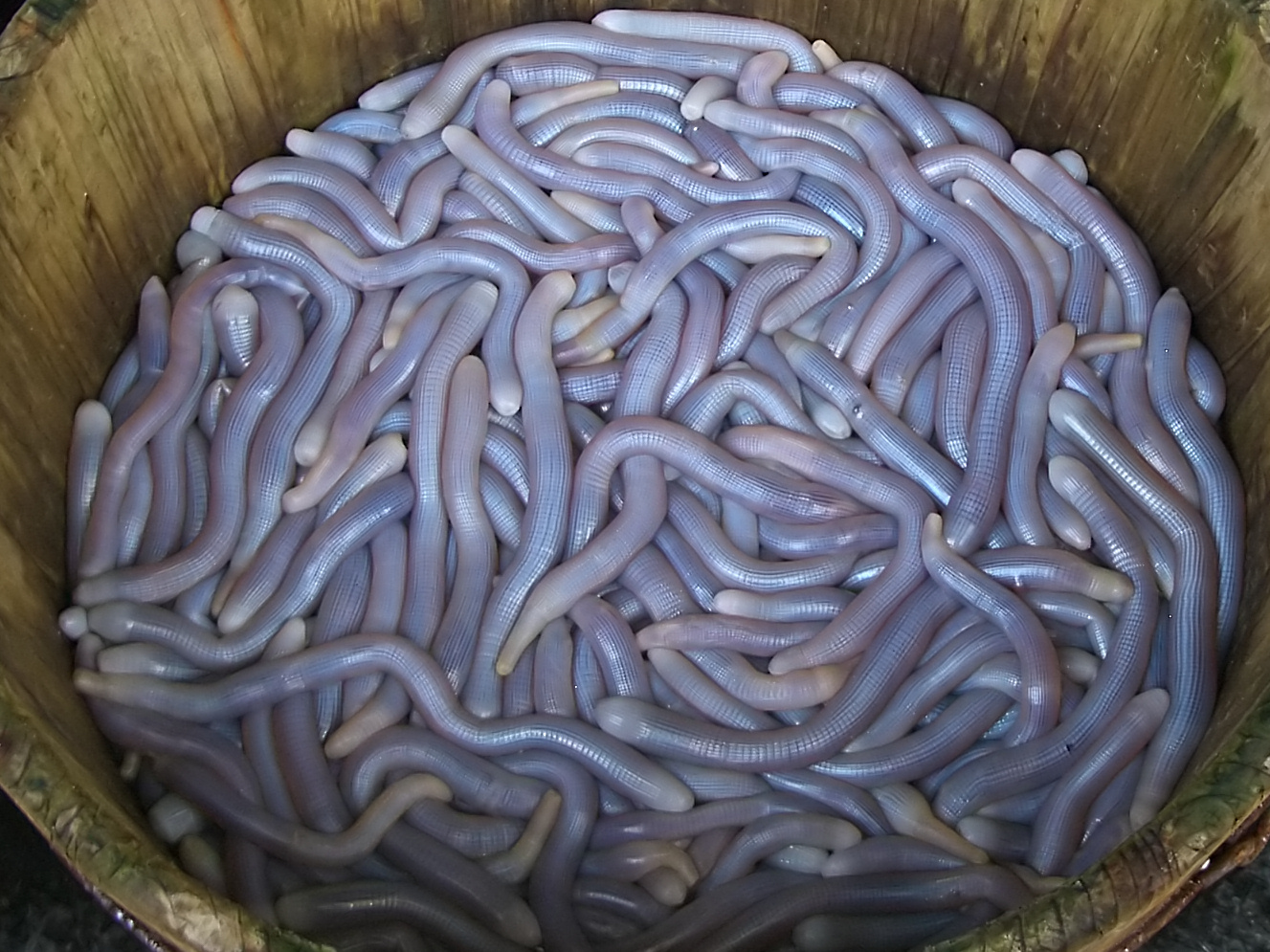
Sea Worm Jelly

Though it may sound unappetizing, most translators end up calling Xiamen's 土笋冻 (tŭ sŭn dòng) “sea worm jelly.” Perhaps you think this is a colorful euphemism, or a lost-in-translation moment. In fact, sea worm jelly is exactly what this is.


The primary ingredients are sipunculid worms harvested from shallow water and muddy beaches on the coast of Fujian.

Here's what they look like. Photo credit: Wikimedia User:Vmenkov

A bunch of these worms are boiled, which releases a slimy collagen into the water that functions similarly to pectin. As the water cools, it is poured into small molds to set like gelatin. A short while later you’ve got small, firm, wiggly mounds of cloudy yellow-gray gelatin in which are suspended long, white worm carcasses. Before you receive a bowl of tŭ sŭn dòng, the vendor will cover it with some combination of chili sauce, mustard, wasabi, soy sauce, vinegar, and cilantro to give it some strong flavors. So what does sea worm jelly taste like, I hear you asking? Frankly, not too much on its own. It tastes and feels like cool, smooth, unflavored (albeit mildly sour and briny) gelatin with some slightly chunkier textures within. The real flavor comes from the sauces on top, which can give it a powerful, sinus-clearing kick. One of the joys of street food is finding truly novel things to eat, and a gelatin made from boiled worms dug up from beach mud is likely to be mightily novel for most people. For a uniquely local street food experience, you really can’t go wrong with tŭ sŭn dòng.

Wednesday, May 20, 2015

Big News

Hello, friends, followers, Sinophiles, and street food lovers. As you might know, I've been working on this book for a good long time now. Several months ago, I posted a three-year update explaining where things stood on getting it out onto the market. Among the reasons I cited for it not being finished was that I was taking some time to look for a publisher, rather than going straight to self-publishing. At the time I said, "I am going to keep heading that direction [i.e. searching for a publisher] for a few more months. If nothing pans out then I will go the self-publishing route."

Well, here we are a few months later, and I'm very pleased to announce that something did, in fact, finally pan out. Today I'm happy to share that I officially have a publisher for my book! My new favorite publishing house is Blacksmith Books, an independent Hong Kong-based publisher that "focuses on publishing China-related non-fiction." The contract is signed and we are now moving forward into the editing stage of the process. If they are looking forward to working with me as much as I am looking forward to working with them, I think it's safe to say that this will be a great partnership.

So, big sigh of relief over here in North Carolina. No more emailing publishers and agents and getting no responses or "no" responses. I'm thrilled to be at the point where I am now--closer than ever to getting this book off of my computer and into a bookstore near you. If you're wondering when that might happen, I am afraid I don't have a clear answer for you. But you can be sure that I will keep you updated here (and on my Facebook page). In the meantime, sit tight and know that Blacksmith and I are working hard to have a finished copy in your hands as soon as possible.

So that's the update. Thanks to all for your continued support. This has been a long process, and I am ever grateful for your steadfast readership and interest.

Saturday, March 21, 2015

Beer!

Ask anybody outside of China to name as many Chinese beers as they can, and I suspect very few would get past Tsingtao.

Right?

It is well-known throughout much of the world as well as in China, where it comes from the country’s second largest brewery. So why would a beer available in its recognizable green bottles all over the world be included on a website meant to highlight hyper-local street foods? Easy: because in its home city of Qingdao (Tsingtao is an earlier transliteration of the city’s name), you can purchase it by weight on the street. The Tsingtao brewery was founded in the early twentieth century when Qingdao was under German rule as part of the Kiautschou Bay concession (1898 – 1914). Of course establishing a brewery was a priority for the Germans living in Qingdao, so they built it in 1903 and it has been operating ever since. Think about that—it has stayed open while the city was controlled by Germany, Japan (twice), the Republic of China, and the People’s Republic of China. It was nationalized for many years (at which time the Chinese government changed some of the strict German beer rules to allow rice in the recipe) until the early 1990s when it was privatized once again. The Tsingtao brewery has been through a lot during its long history in the area, and it is a source of pride for many citizens. So in a way, it is no surprise that the brewery’s flagship product is available all over the city. Poke your head into many of the city’s hole-in-the-wall restaurants and you will find a keg of beer waiting for you. Ask the vendor for a bag (yes, a bag), fill it up as much as you want, weigh it, pay for it based on the weight, and you’re on your way.


You can either drink it right out of the bag or relocate it to a mug when you reach your destination. Qingdao is the only city I’ve ever visited where you can buy beer in a bag by the kilogram and then drink it as you wander the streets. It’s a unique opportunity that has resulted from the city’s unique history. Don’t miss it.

Tuesday, February 24, 2015

Thoughts on the Chinese Revo-loo-tion

It's been a good long while since I've written a post that focused more on general travel in China and less on street food or my writing progress, but an article I read recently has encouraged me to break that fast. Here's the article. If you don't feel like clicking over, I can give you the short version: Li Jinzao, the head of China's National Tourist Administration, has announced that China is going to begin a massive overhaul of their toilet infrastructure, with a focus on tourist locations. That may very well be good news for China and for tourists, but I have to admit that I'm of two minds on the subject. On the one hand, as I've written before, Chinese public bathrooms can be somewhat dismal affairs. Every traveler has a couple of stories about ridiculous bathroom situations in China. Generally you'll have your pick from a row of squat toilets, possibly with dividers between them. If you're lucky, you may run across a bathroom with doors on the stalls. If you're less lucky, you may find yourself in a bathroom with a single long trough and no privacy at all. Toilet paper and soap are almost never provided. So, needless to say, it can take a little getting used to, and perhaps there is some room for improvement. On the other hand, getting back to my two minds on the subject, I am a pretty strong believer in the traveler ethos that encourages adaptation to the local culture. If these toilets are what the locals are happily using, then doggone it, that's what I'm going to use. It's not my place to adopt a snooty sense of cultural superiority based on something as silly as different standards for privacy and odors.

Now, it's possible that there is a great amount of support for this toilet-updating venture coming from the Chinese hoi polloi. If that's the case, then I'm all for it. If anybody has the right to demand a change in the way people are being treated at some of their most vulnerable moments, it's the people themselves. Somehow, though, I fear that the main reason behind the change are the big tourist dollars. This paragraph in the article certainly seems to point that way:

"Following complaints from visitors, Beijing last week announced the start of a revolution (or "revo-loo-tion") that should see the number of toilets at tourist sights rise, along with their quality." [All emphasis mine.]

Or this one from another article:

"Li admitted that the current state of public toilets in the country leaves much to be desired and should be improved to meet with international tourism standards." [Once again, emphasis mine.]

I am reminded in all of this of a singularly strange meeting I attended when I lived in Jiujiang, Jiangxi, in 2006 - 2007. Jiujiang is not a big draw for tourists (although it's a good starting point for visiting Lushan), particularly for Western tourists. That's part of what I love about the city. And yet one night my wife and I, along with three or four others from the city's very small expat population, were invited as guests of honor to a panel discussion with local government officials about how to make the city more appealing to Western tourists. We cringed as some of our fellow laowai complained about the lack of English menus at restaurants or how loud some of the streets were (not at night...on Saturday afternoons...). We were put on the spot to say something to these officials, so we stumbled through some silly thoughts about public benches in pretty areas or something, and left it at that. Everybody went home, the government officials (rightfully) ignored all of the ideas that were suggested that night, and Jiujiang stayed just the way it was.

The point is, a city shouldn't have to change who it is just to attract tourist money, and neither should a country. I understand the economic realities of the situation, of course. Sometimes your local economy relies on tourists, and if you can get a few extra RMB by updating the toilets, then I certainly can't blame you for making the change. But I think it's kind of sad. We tell kids all the time to be true to themselves and not worry about what others think of you, but even nations can fall victim to that sort of peer pressure.

Now, just to be clear, I'm not saying I think China should stay in some sort of dark age of toilets just so that travelers can have what they consider an "authentic" experience. That sort of thinking seems to me equally as patronizing as it is to insist China change to meet your standards. All I'm saying is that the desire to change should come from within. Perhaps that's happening here, in which case everybody wins (hooray!). But if not, then it seems like China is losing a little bit of itself.